
Shared carbon hubs
Pyruvate, acetyl-CoA, oxaloacetate, 2-oxoglutarate, and related stations connect routes without pretending every shared carrier is a meaningful shortcut.
Follow carbon, nitrogen, electrons, and activated groups through a source-linked human metabolic field. Begin with the whole system, then focus until every reaction becomes readable chemistry.
Loading authored routes and source-linked stations.
Pyruvate, acetyl-CoA, oxaloacetate, 2-oxoglutarate, and related stations connect routes without pretending every shared carrier is a meaningful shortcut.
The same molecule in cytosol and mitochondrial matrix appears as two pools joined only by a sourced transport event.
The whole field stays spare. Focus maps reveal pathway rails; pathway and reaction focus reveal source-backed structures, enzymes, cofactors, and evidence.
Lines show represented chemical connectivity and direction, not tissue abundance, rate, thermodynamic commitment, or physiological flux.
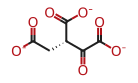
The atlas keeps NAD-dependent and NADP-dependent isocitrate dehydrogenase contexts distinct. At reaction focus, (S)-oxalosuccinate appears between oxidation and decarboxylation with its own structure, charge, stable ChEBI identity, and component Rhea records.
The map shows curated reaction direction and compartment identity, not measured flux, concentration, tissue dominance or thermodynamic magnitude. Animated traversal marks a selected route only.
This visual projection is an authored learning layer over release-pinned Reactome events, Rhea net reactions, ChEBI identities, and cited literature. Every contextual connection is marked separately from event-backed chemistry.
Read the methodologyInspect source releases